Welcome to SEMO Electric Cooperative & GoSEMO Fiber
Without electricity and broadband, you risk missing out on family connections, learning, earning a living, and entertainment.
Live life to the fullest with safe, reliable, and affordable electricity and broadband services.
We serve homes, farms, churches, schools, and businesses to enhance lives with juice and fiber.
Our mission is to improve lives safely with dependable electricity and broadband services.
Electricity
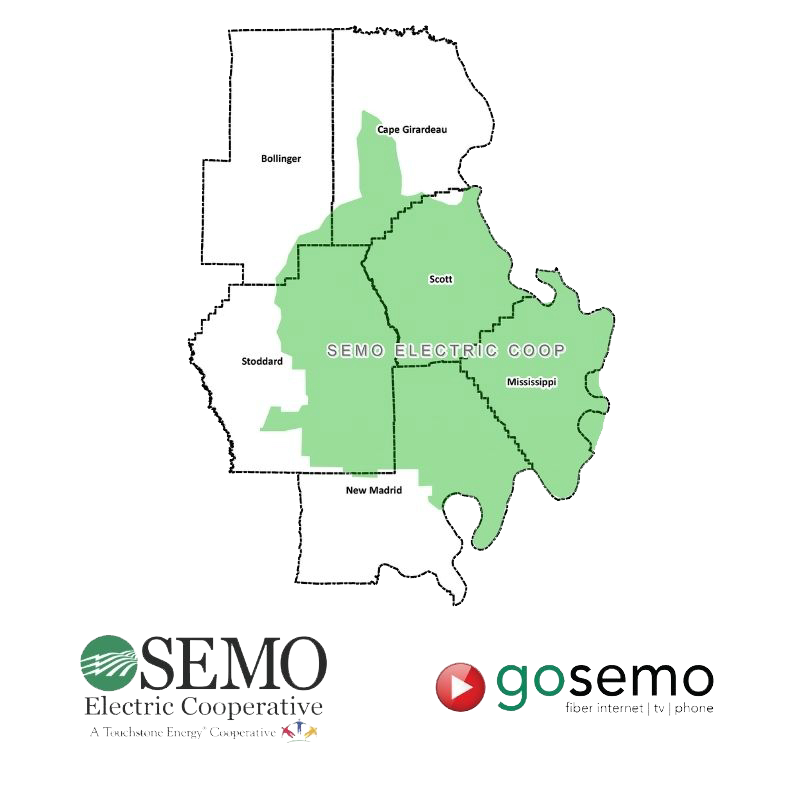
SEMO Electric’s service area spans 75 miles in the Bootheel region of Missouri, from humble beginnings to thousands of homes, farms, and businesses.
Serving Scott, New Madrid, Mississippi, Stoddard, Bollinger, and Cape Girardeau counties.
Established in 1938 by forward-thinking farmers with help from the Rural Electrification Administration (REA).
Part of a 3-tier cooperative system with power generated by Associated Electric Cooperative, Inc., and transmission services from M & A Electric Power Cooperative.
Broadband
Fiber-to-the-home initiative began in 2017, offering high-speed, reliable, and convenient fiber technology.
Held to a higher service standard by being of, by, and for Missouri’s electric cooperatives.
Internet and phone packages with complimentary professional installation, in-home training, unlimited data without data caps, and no binding contracts
They are open to all persons able to use their services.
Membership is available to those willing to accept the responsibilities.
Cooperatives operate without gender, social, racial, political, or religious discrimination.
Democratic Member Control
Cooperatives are democratic organizations with control vested in their members, who actively participate in policy-setting and decision-making.
Elected representatives are held accountable to the membership.
In primary cooperatives, members enjoy equal voting rights, following a one-member, one-vote principle.
Cooperatives at other levels are structured in a democratic fashion.
Members’ Economic Participation
Members contribute equitably to and democratically control the capital of their cooperative. Typically, a portion of this capital is considered common property within the cooperative.
Compensation for capital subscribed as a membership requirement is often limited, if provided at all.
Members allocate surpluses for various purposes, including cooperative development, potentially establishing indivisible reserves.
Surpluses may also benefit members in proportion to their transactions with the cooperative and support other approved activities as determined by the membership.
Autonomy & Independence
Cooperatives operate autonomously, guided by self-help principles.
Members have control over cooperative decisions and governance.
When forming agreements with external organizations or governments, cooperatives prioritize democratic control by their members.
Cooperative autonomy is preserved even when raising capital from external sources.
Education, Training, & Information
Education and training are offered to members, representatives, managers, and employees.
This empowers them to contribute effectively to cooperative development.
Cooperatives also inform the general public, including youth and opinion leaders, about cooperation’s nature and benefits.
Cooperation Among Cooperatives
Cooperatives enhance their members’ service and bolster the cooperative movement.
This is achieved by collaborating through local, national, regional, and international structures.
Concern for Community
Cooperatives prioritize member needs.
They also strive for sustainable community development.
Their policies are determined and accepted by their members.